GITHUB CONTRIBUTION DISCOVERY · .NET / C#
Where do I start with an open-source contribution?
When I want to contribute on GitHub, the work starts before I write any code. Is the repository active? Is the issue scoped clearly? Can I get the project running locally? I ask the same questions each time I switch repositories.
OpenSourceHunter is a local tool I built to bring that research into one workflow. It discovers .NET and C# repositories on GitHub, collects open issues, and ranks candidates with reasons to review them. It also helps me prepare a local checkout and track a pull request once I submit it.
From GitHub search to a review queue
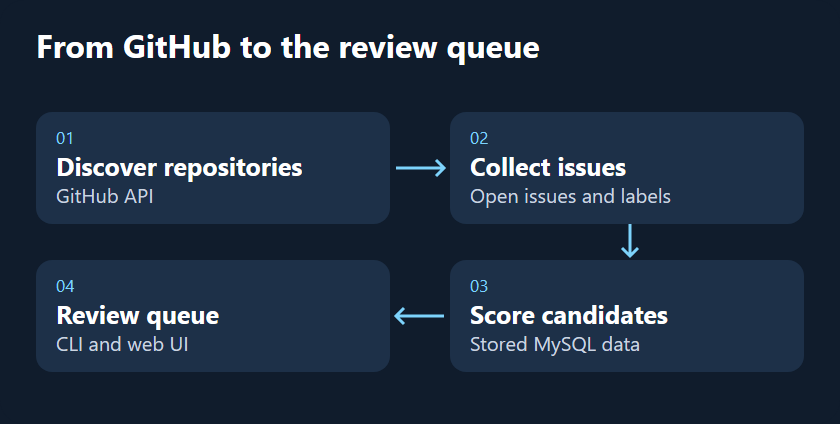
- Discover repositories. The tool searches GitHub for .NET and C# projects and stores repository metadata locally.
- Collect open issues. It excludes pull request records and issues outside the configured recency window, then normalizes contribution labels.
- Rank candidates. The rule-based score uses signals such as repository activity, issue recency, description, comment count, and labels. Scores range from 0 to 100. Ranking and reporting use stored data.
- Review the reasons. The CLI report and local web UI show the score, contribution type, estimated difficulty, rationale, and suggested first step. A clearly described issue labeled
help wantedin an active repository, for example, can move up the queue.
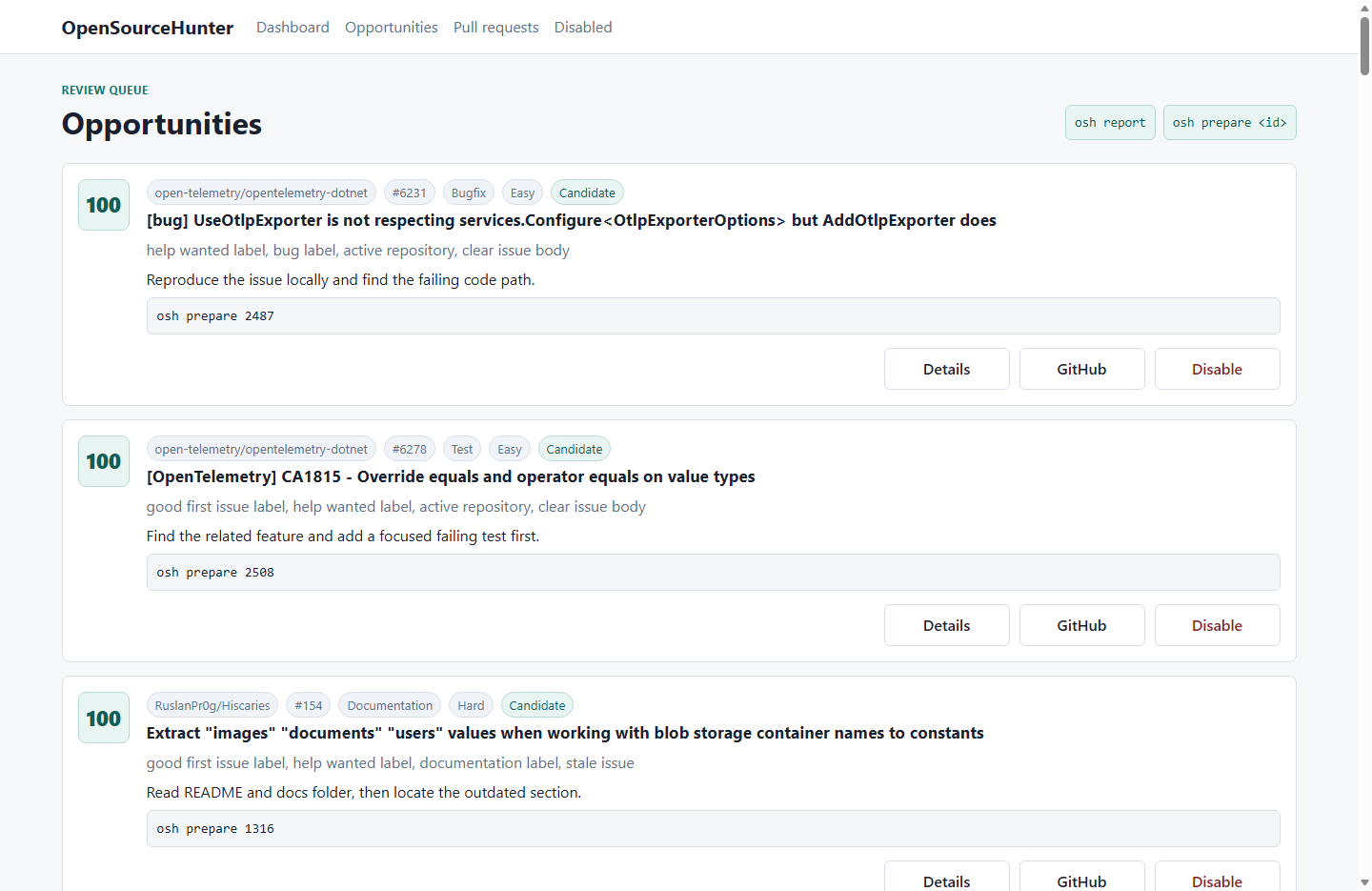
The local review interface, captured from a saved application view with the local filesystem path removed.
From review to pull request tracking
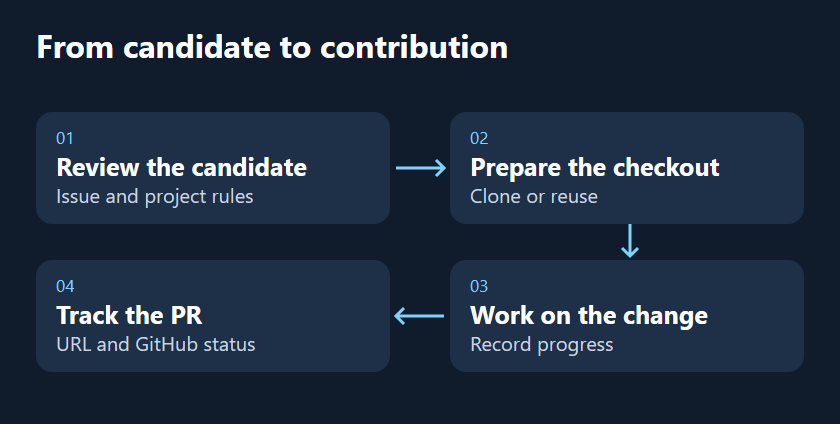
I open a candidate on GitHub to review its scope and the project’s contribution rules. I can disable unsuitable issues or repositories with a reason and a note, and restore them later.
osh prepare <id> clones the selected repository or reuses an existing checkout. It inspects README, CONTRIBUTING, and build files and suggests where to start. I can record work in progress, attach a pull request URL, and sync its status from GitHub. The developer chooses the issue, makes the change, and submits the PR.
Implementation
I built the CLI and web interface around the same application rules and data store. C# and .NET 8 run the workflows. ASP.NET Core Razor Pages serves the review UI. Entity Framework Core and MySQL persist repositories, issues, scores, and contribution records. The GitHub API supplies discovery, issue, and pull request data, and Git prepares the local checkout.
OpenSourceHunter is a single-user local MVP. Its main value for me is seeing why an issue is in the queue and what I can do next to evaluate it.